

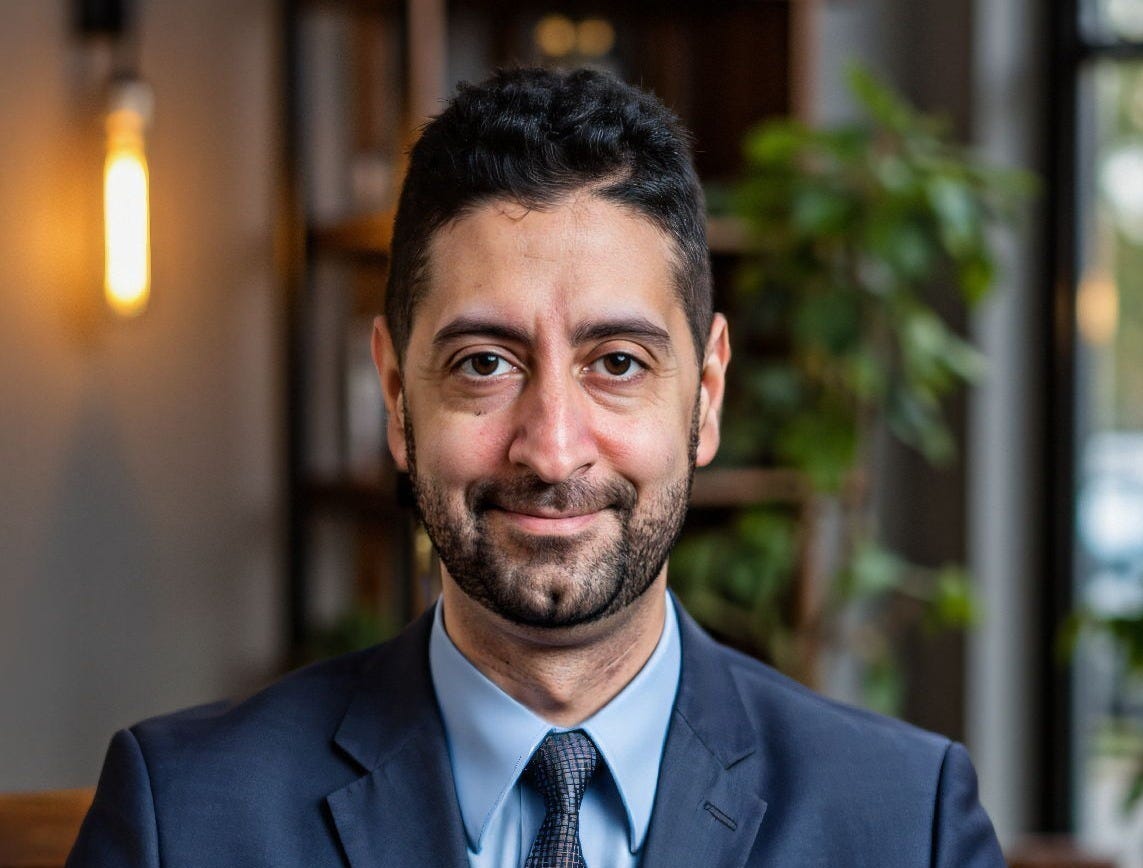
by Shawn Jahromi
Doctoral researcher: Digital Transformation and AI Governance
and operator with experience advising leaders in high-consequence environments
December 30, 2025
Writer Notes: “The piece explores why organizations reward certainty even when conditions are unstable how learning stalls once authority hardens and how leaders unintentionally train teams to protect narratives rather than surface reality.
“It also explains how intellectual humility must be embedded into decision rights escalation paths and review mechanisms rather than expected as an individual trait.
“This is written for senior leaders and board members who operate in high consequence environments where learning lag creates material risk and delayed failure.”
Most leadership conversations treat intellectual humility as a personality trait.
Be open minded.
Be curious.
Listen more.
That framing is comforting. It makes humility feel optional, personal and moral. It also misses the point entirely.
In complex organizations, intellectual humility is not about temperament. It is about risk. When humility is absent, organizations do not simply become arrogant. They become brittle. And brittle systems fail quietly long before they fail publicly.
Why Confidence Keeps Winning Even When it Should not
Organizations reward certainty. Promotions, influence and authority tend to accrue to those who speak clearly, decisively and confidently. In stable environments, that works reasonably well. Experience compounds. Patterns repeat. Confidence correlates with correctness often enough to reinforce the habit.
Complex environments break that relationship.
When conditions change faster than institutional learning cycles, confidence becomes misleading. Leaders who were once right continue to sound right even as reality shifts underneath them. The organization keeps following because the signals of authority remain intact. Titles, track records, reputation.
No alarm triggers because nothing appears obviously broken yet.
This is how learning stalls. Not because people stop thinking but because systems stop allowing doubt to surface.
The Hidden Cost of Certainty
When leaders project certainty, teams adapt. They learn what is safe to say and what is not. Questions become risks. Alternative interpretations become distractions. Bad news gets softened. Ambiguity gets resolved upward rather than explored outward.
Over time, organizations stop testing their assumptions. They defend them.
This is not malicious behavior. It is rational behavior inside poorly-designed decision systems. When dissent is interpreted as disloyalty or incompetence, silence becomes competence. When escalation paths punish messengers, messages stop moving.
The Cost is Delayed Failure
Most institutional failures are not sudden. They are slow accumulations of ignored signals, deferred questions and protected narratives. By the time consequences become visible, leaders are often shocked. Not because warnings did not exist but because the system trained itself not to hear them.
Humility cannot be expected. It must be engineered.
This is where the leadership literature goes wrong. It asks individuals to be humble inside systems that punish humility.
You cannot fix a structural problem with a personality request.
Intellectual humility must be designed into governance. That means embedding it into how decisions are reviewed, challenged, escalated and revised. Not as a value statement, but as an operating requirement.
Practical Examples
Decision reviews should require articulation of assumptions, not just conclusions.
Major decisions should include explicit uncertainty statements, not confidence theater.
Escalation mechanisms should protect those who surface contradictory evidence.
Post-decision reviews should examine what was missed, not just what succeeded.
These are not cultural niceties. They are control mechanisms.
The difference between confidence and correctness.
High performing organizations learn to separate authority from accuracy. Authority decides. Accuracy informs. When those two collapse into the same person or role, risk concentrates.
Intellectual humility, properly understood, is the discipline of keeping those roles distinct.
Leaders do not lose authority by acknowledging uncertainty. They lose authority when reality contradicts them and the organization has no way to adapt. The former builds resilience. The latter builds fragility.
In safety-critical industries, this distinction is well understood. Aviation, medicine, nuclear operations. Checklists exist not because experts lack skill but because systems acknowledge that expertise degrades under complexity and pressure.
Business and technology leadership often forget this lesson at scale.
Why This Matters More Now
Digital transformation, AI systems and platform-based organizations amplify the cost of wrong assumptions. Decisions propagate faster. Errors scale wider. Feedback arrives later.
In these environments, intellectual humility is no longer a leadership virtue.
It is a governance requirement.
Organizations that confuse decisiveness with infallibility will move quickly until they cannot stop. Organizations that institutionalize learning will appear slower until they avoid catastrophic reversals.
The difference shows up not in quarterly results but in survivability.
What Leaders Should Ask Themselves
Not whether they are personally humble. That question is irrelevant.
Instead ask:
Where can disagreement surface without penalty?
Who is authorized to challenge assumptions and when?
How does the organization detect when confidence has outpaced evidence?
What mechanisms exist to revise decisions without reputational damage?
If those questions do not have concrete answers, humility is not present regardless of how leaders describe themselves.

Final Thought
Organizations do not fail because leaders are arrogant. They fail because systems reward certainty and suppress correction.
Intellectual humility is not about being unsure. It is about being correctable.
And in complex environments, the ability to be corrected is the most valuable form of intelligence an organization can possess.
Shawn Jahromi is a doctoral researcher in Digital Transformation and AI Governance and an operator with experience advising leaders in high consequence environments. His work focuses on decision systems, institutional risk and how organizations fail long before they collapse.
The Communication Intelligence Insights & Advisory section accepts pitches and submissions that are human (not AI) written and provide important expertise and recommendations on meaningful topics in a well-written, interesting manner.

Interesting and useful article. Thank you.
I would add one thing (separate from the article's main content):
'Soft skills' is misleading terminology.
Most attributes labelled that way are essential human skills that fall into various categories: communication, people-focused, thinking-related etc.
And there's nothing 'soft' about any of them ☺️